

- Home
- Services
- Automated Translation
- TECHVED AI
- Case studies
- CLIENTS
- More

Let's get started
We believe in advancing your business growth with innovative ideations and strategies
Get In Touch


 Back
BackAI-Powered Attacks Are Here: How Enterprises Must Rethink Cybersecurity
#CyberSecurity #AICybersecurity #EnterpriseProtection

Jay Anthony
15 April 2026 | 8 min read
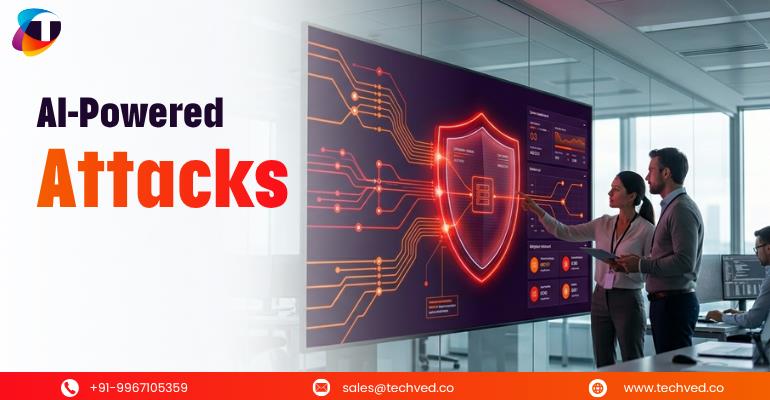
Imagine being a security guard at a jewelry store equipped with the best locks. But one morning, you realize thieves didn't break in. They used a digital clone of the owner's voice to trick you into opening the vault. This is exactly what happens with AI-powered cyber attacks.
Cyber security professionals now face adversaries that learn, adapt and scale attacks at machine speed. AI-powered cyber attacks don't follow predictable patterns recognized by trained security teams. They evolve in real time based on defensive responses.
Read on to understand how AI in cybersecurity is reshaping both offense and defense, what enterprise cybersecurity strategy requires in this new landscape and how organizations must adapt protection approaches for intelligent adversaries.
How AI-Powered Cyber Attacks Differ
AI-powered cyber attacks operate fundamentally differently than conventional and predictable pattern-following threats. They use machine learning to identify vulnerabilities faster than human analysts. They generate convincing phishing content at scale and adapt tactics based on defensive responses in real time.
Key characteristics of AI-enabled threats:
- Automated vulnerability discovery scanning millions of endpoints simultaneously
- Polymorphic malware that changes signatures to evade detection
- Deepfake audio and video for social engineering attacks
- Password cracking using neural networks predicting likely combinations
- Reconnaissance that maps network topologies and identifies high-value targets autonomously
- Attack timing optimization based on when defenses are weakest
The future of AI in cyber security involves adversarial AI systems probing defenses, learning from failures and optimizing attack strategies without human direction.
The Rising Tide of AI-Powered Cyber Attacks
Adversaries now use generative models for hyper-realistic phishing and autonomous agents to probe for network weaknesses. An effective enterprise cybersecurity strategy must now account for these high-speed automated threats.
Metric / Threat Type
2025-2026 Growth / Statistic
Impact on Enterprise
AI-Driven Cyberattacks
> 28 Million Incidents (Projected)
Massive scale and frequency of automated breaches
AI-Enabled Adversary Activity
89% Year-over-Year Increase
Faster exploitation of vulnerabilities
Agentic Phishing Attacks
> 42% of Global Breaches
Highly convincing, autonomous social engineering
AI Agent Traffic Growth
7,851% Increase
Surge in bot-driven reconnaissance and data scraping
Enterprise Risk Concern
72% Cite Cybersecurity as Top AI Risk
Shift in focus toward securing AI-driven workflows
Sources: SentinelOne 2026 Statistics; CrowdStrike 2026 Global Threat Report; McKinsey State of AI Trust 2026; HUMAN Security Benchmark Report.
As the data shows, the volume and speed of AI-powered cyber attacks are overwhelming traditional defenses. This is why a leading cyber security solution provider will always emphasize AI-driven defense mechanisms.
Why Traditional Cyber Security Defenses Are Failing
Signature-based detection fails against attacks that constantly evolve. Static security policies can't respond to threats that change tactics mid-campaign. Manual threat analysis can't keep pace with automated reconnaissance.
Cyber security solutions designed for human attackers make assumptions about attack speed, consistency and patterns that AI adversaries violate constantly.
The defender's dilemma intensifies: security teams must defend every possible entry point perfectly while attackers only need to succeed once. AI amplifies this asymmetry by letting attackers probe millions of potential vulnerabilities simultaneously.
Leveraging AI in Cybersecurity for Defense
The threat landscape demands a fundamental shift in enterprise cybersecurity strategy:
- Adopt AI-first defense- Traditional security is no longer sufficient against adversaries using AI to outwit conventional measures
- Secure AI systems as critical infrastructure- Apply the same rigor to AI agents as human identities with strong authentication and conditional access controls
- Implement continuous validation- Monitor for abnormal access patterns and credential exposure across SaaS and AI ecosystems
- Invest in autonomous threat detection- Agentic AI can orchestrate multiple agents across the threat lifecycle from hunting to remediation
The cost of inaction is staggering. Global cybercrime damages are set to exceed $23 trillion by 2027.*
Building AI-Ready Enterprise Cybersecurity Strategy
Assume breach as starting point: Enterprise cybersecurity strategy must plan for successful intrusions rather than assuming perfect prevention. This means detection and response capabilities become as critical as prevention.
Invest in AI-powered defense platforms: Cyber security solution provider selection should prioritize AI capabilities for threat detection, behavioral analysis and automated response.
TECHVED delivers cyber digital solutions integrating AI-powered threat detection with comprehensive security architecture.
Develop AI security expertise internally: Cybersecurity for AI systems requires understanding both security fundamentals and AI capabilities. Teams need skills spanning data science, threat intelligence and security engineering.
Implement continuous learning systems: AI defenses improve through exposure to attacks. Cyber security solutions should include feedback loops where detected threats train models to recognize similar future attacks.
Monitor AI systems for compromise: Cybersecurity for AI systems means protecting the AI tools defending your environment. Adversaries targeting detection algorithms or poisoning training data can blind defenses.
Maintain human oversight and judgment: AI enhances rather than replaces human security teams. Critical decisions about threat response, acceptable risk and security policy still require human judgment informed by AI insights.
Partner with TECHVED for AI-Ready Cyber Security
At TECHVED, we deliver cyber security solutions designed for the AI era. Our cyber digital solutions help enterprises build resilient defenses against AI-powered threats. As a trusted cyber security solution provider, we combine threat intelligence with proactive defense strategies.
Secure your enterprise today with TECHVED’s cyber security solutions.
FAQs
What are AI-powered cyber attacks? AI-powered cyber attacks use machine learning to automate vulnerability discovery, generate convincing phishing content, adapt tactics in real time and scale sophisticated attacks beyond human attacker capabilities.
How does AI in cybersecurity improve defense? AI in cybersecurity enables behavioral anomaly detection, automated threat hunting, predictive intelligence, adaptive authentication and response at machine speed that traditional rule-based systems can't achieve.
What is enterprise cybersecurity strategy for AI threats? Enterprise cybersecurity strategy for AI threats assumes breach, implements zero-trust architecture, invests in AI-powered defense platforms, develops AI security expertise and maintains human oversight.
What is cybersecurity for AI systems? Cybersecurity for AI systems means protecting the AI tools defending your environment from adversaries targeting detection algorithms, poisoning training data or compromising machine learning models.
How should enterprises choose cyber security solutions for AI threats? Choose cyber security solutions demonstrating AI capabilities for threat detection, proven implementations, continuous learning systems and integration with existing security architecture rather than just AI marketing claims. g
Most Popular
Data-Driven Decision-Making: The Overlooked Foundation of Digital Transformation
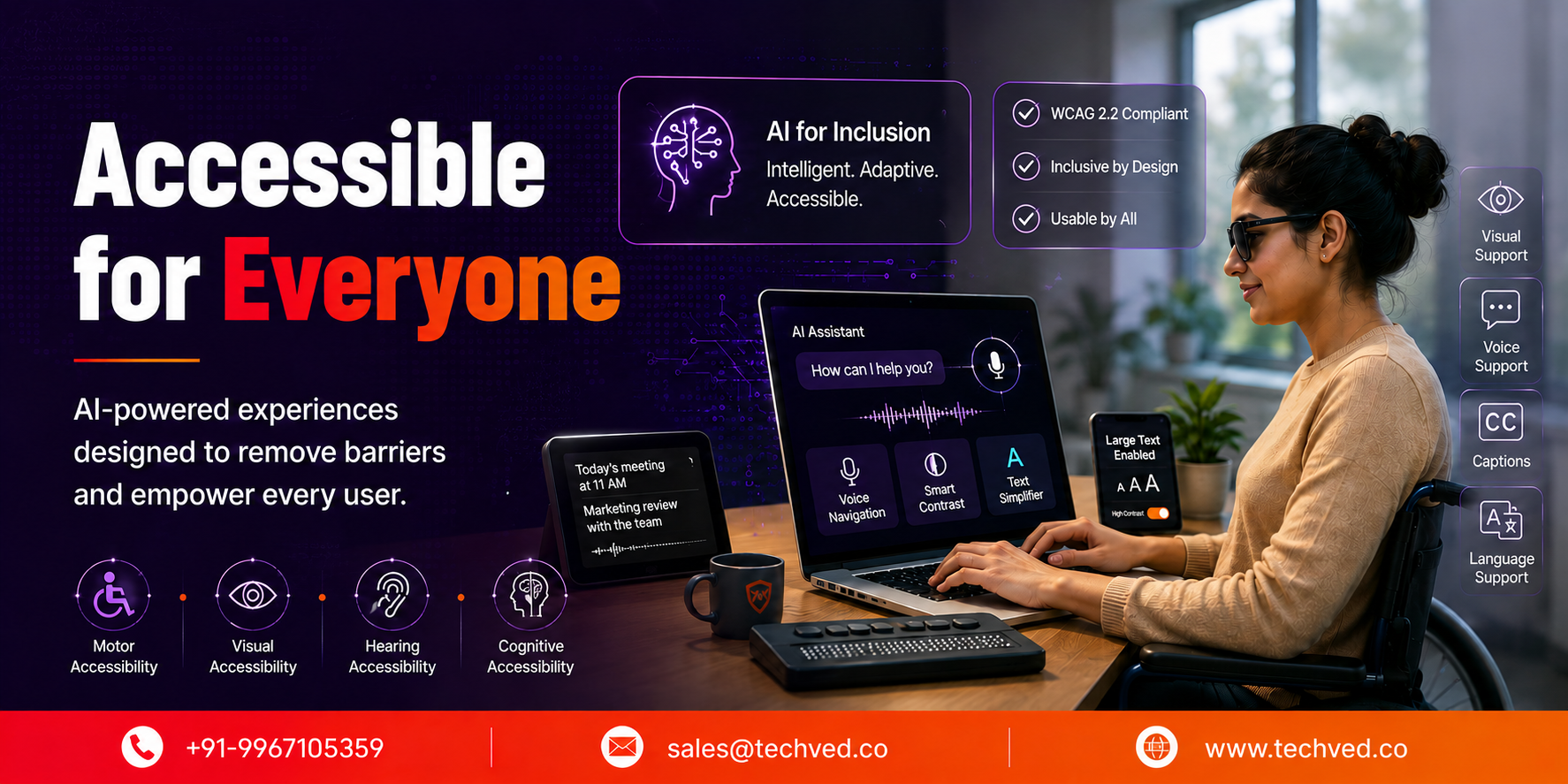
Accessibility in the Age of AI: Designing Inclusive Intelligent Experiences
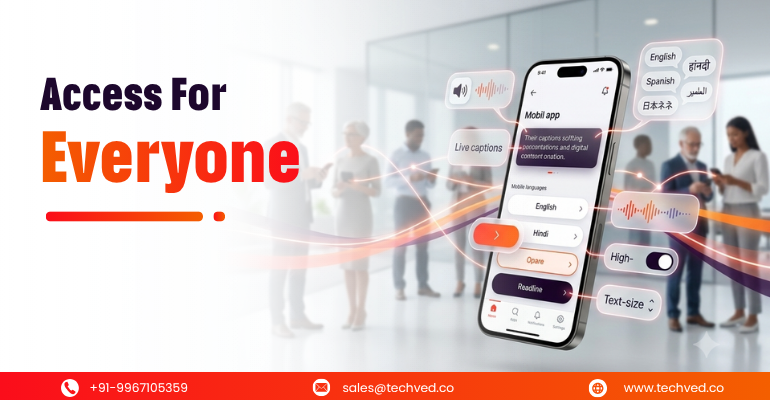
Inclusive Mobile Design: Building Accessible Apps for Global Users

Anticipatory UX: Designing User Experiences That Predict Intent
Safe Innovation: Implementing AI Chatbots with Strict Data Privacy Guardrails
DPDP 2025 Readiness: Building Credible Platforms for a Data-First World
The Trust Economy: Viewing Cybersecurity as a Growth Strategy
Written By
Jay Anthony
Marketing Head
He led efforts to develop a fully integrated marketing communications plan and growing team. He is responsible for successful corporate re-brand and update of all branded assets.

Stay up-to-date with
all new market trends and
happenings
 #DataDrivenDecisionMaking #DigitalTransformation #EnterpriseAnalytics #BusinessIntelligence #TECHVED #TECHVEDConsulting
Data-Driven Decision-Making: The Overlooked Foundation of Digital Transformation
#Accessibility #DigitalAccessibility #InclusiveDesign #CustomerExperience #DigitalTransformation #EnterpriseAI #TECHVED #TECHVEDConsulting #ExperienceEngineering
Accessibility in the Age of AI: Designing Inclusive Intelligent Experiences
#InclusiveMobileDesign #MobileAccessibility #DigitalAccessibility
Inclusive Mobile Design: Building Accessible Apps for Global Users
From Ideation To Digital Transformation
We take care of all your needs


