

- Home
- Services
- Automated Translation
- TECHVED AI
- Case studies
- CLIENTS
- More

Let's get started
We believe in advancing your business growth with innovative ideations and strategies
Get In Touch


 Back
BackData-Driven Decision-Making: The Overlooked Foundation of Digital Transformation
#DataDrivenDecisionMaking #DigitalTransformation #EnterpriseAnalytics #BusinessIntelligence #TECHVED #TECHVEDConsulting

Jay Anthony
4 August 2026 | 7 min read
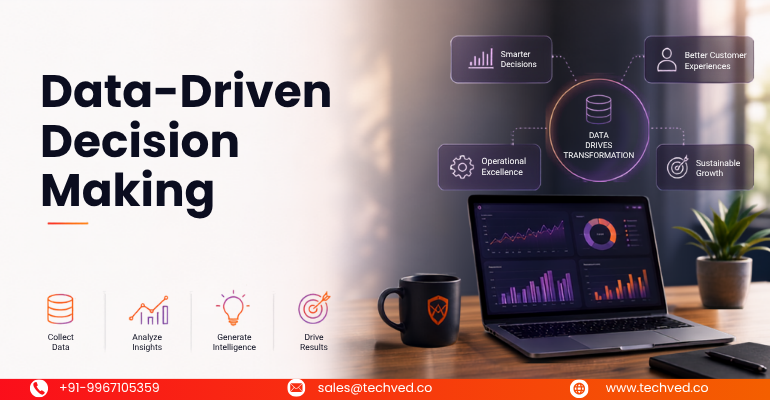
A retail enterprise invests heavily in a new AI-powered recommendation engine, a modernized e-commerce platform and an automated supply chain system. Eighteen months in, adoption is uneven, ROI is unclear and leadership still makes major calls based on instinct and quarterly reports rather than the data these new systems generate. The technology works. The transformation hasn't actually happened.
This is one of the most common and least discussed failure points in digital transformation. Organizations modernize their tools before they modernize how they decide. Without data-driven decision-making at the core, even the most advanced technology stack becomes expensive infrastructure rather than a genuine driver of change.
Why Data-Driven Decision-Making Matters More Than Ever
Digital transformation generates enormous volumes of data — customer behavior, operational performance, market signals — often for the first time in an organization's history. Yet generating data and using it to decide are two very different capabilities.
Enterprises that transform their technology without transforming their decision-making culture end up with dashboards nobody consults, analytics teams whose findings go unused and leadership still governing by intuition. The gap between data availability and data usage is where most digital transformation value quietly disappears.
The Intersection of Data and Digital Transformation
Every pillar of digital transformation — customer experience, operations, product development — produces data that can sharpen decisions, if the organization is built to use it. A well-designed digital transformation strategy treats data infrastructure and decision-making processes as inseparable, not sequential.
This means embedding data access into the actual moments where decisions get made, not after the fact in a quarterly review. It means building confidence in the numbers, not just visibility into them.
Challenges Enterprises Need to Address
As organizations build out their data capabilities, several recurring obstacles get in the way of real data-driven decision-making:
- Data scattered across disconnected systems with no single reliable source of truth
- Dashboards and reports that are accurate but never consulted before decisions are made
- Leadership teams more comfortable with experience-based judgment than statistical evidence
- Analytics functions siloed away from the business units that need their insights most
- A lack of clear ownership over which data drives which decisions
These challenges are rarely technical at their root. They are cultural and structural, which is exactly why they persist even after the technology is in place.
Building a Data-Driven Foundation
Becoming genuinely data-driven requires deliberate change across process, culture and leadership, not just tooling.
Design Decisions Around Data From the Start
Data-driven decision-making should be built into how strategic and operational decisions are structured, not retrofitted after a decision has already been made informally.
Build Trust in the Data
Adoption fails when people don't trust the numbers. Establishing clear data governance, consistent definitions and visible data quality standards is what turns skepticism into reliance.
Bring Data to the Point of Decision
Insights that live in a separate dashboard, disconnected from where decisions actually happen, rarely get used. Embedding relevant data directly into workflows and decision points dramatically increases the odds it gets acted on.
Measure the Decisions, Not Just the Data
Enterprises should track how often decisions are actually informed by data, not only how much data is being collected. This reframes data-driven transformation as a behavior to build, not a system to install.
Business Benefits of Data-Driven Transformation
Enterprises that successfully embed data-driven decision-making into their digital transformation see returns well beyond faster reporting:
- Faster, more confident strategic decisions
- Reduced reliance on assumption-based planning
- Better allocation of investment toward what's actually working
- Earlier detection of operational and market risks
- Stronger alignment between leadership and frontline execution
Most importantly, these benefits compound. Better decisions generate better data about their outcomes, which improves the next round of decisions.
Data-Driven Decision-Making in Action
Consider an enterprise navigating a shift in customer demand. In a traditional model, this shift would surface weeks later in a sales report, long after the moment to act on it has passed.
In a data-driven model, the same signal appears in near real time through integrated dashboards tied directly to demand planning. Instead of a delayed quarterly reaction, procurement and marketing teams adjust within days — informed by the same data, aligned around the same numbers and moving in the same direction.
The technology enabling this shift already existed in both scenarios. The difference is whether the organization was built to actually use it.
The Future of Data-Driven Enterprises
As digital transformation matures, the enterprises that pull ahead won't be the ones with the most data, but the ones whose decision-making processes are genuinely built around it. This means treating data literacy as a leadership capability, not just an analytics function, and designing decision-making processes with data access built in by default.
Conclusion
Digital transformation is often measured by the technology deployed — new platforms, new automation, new AI capabilities. But the real measure of transformation is whether decisions across the organization actually change.
By treating data-driven decision-making as a foundation rather than an afterthought, enterprises can ensure their technology investments translate into genuinely better judgment, not just better dashboards.
At TECHVED, we help enterprises build digital transformation strategies where data and decision-making are designed together from the outset — so the insights organizations generate actually shape the choices they make.
FAQ's
What is data-driven decision-making in digital transformation?
Data-driven decision-making is the practice of basing business decisions on data analysis and interpretation rather than intuition alone, embedded directly into an organization's digital transformation strategy.
Why do many digital transformation initiatives fail to become data-driven?
Most initiatives modernize technology and data infrastructure without changing how decisions are actually made, leaving valuable data underused by leadership and teams.
How can enterprises build trust in their data?
Trust comes from clear data governance, consistent definitions across teams, and visible data quality standards that make numbers reliable enough to act on.
What is the difference between collecting data and being data-driven?
Collecting data means gathering information; being data-driven means consistently using that information to shape real decisions across the organization.
How does data-driven decision-making improve ROI from digital transformation?
It ensures that investments in technology and automation are validated and adjusted based on real outcomes, rather than left unmeasured, driving accountability and improving returns.
Most Popular
Accessibility in the Age of AI: Designing Inclusive Intelligent Experiences

Inclusive Mobile Design: Building Accessible Apps for Global Users

Anticipatory UX: Designing User Experiences That Predict Intent

Safe Innovation: Implementing AI Chatbots with Strict Data Privacy Guardrails

DPDP 2025 Readiness: Building Credible Platforms for a Data-First World

The Trust Economy: Viewing Cybersecurity as a Growth Strategy

Beyond Translation: Using BHAASHA to Build Cultural Trust
Written By
Jay Anthony
Marketing Head
He led efforts to develop a fully integrated marketing communications plan and growing team. He is responsible for successful corporate re-brand and update of all branded assets.

Stay up-to-date with
all new market trends and
happenings
 #Accessibility #DigitalAccessibility #InclusiveDesign #CustomerExperience #DigitalTransformation #EnterpriseAI #TECHVED #TECHVEDConsulting #ExperienceEngineering
Accessibility in the Age of AI: Designing Inclusive Intelligent Experiences
#InclusiveMobileDesign #MobileAccessibility #DigitalAccessibility
Inclusive Mobile Design: Building Accessible Apps for Global Users
#AnticipatoryUX #PredictiveUX #AIinUXDesign
Anticipatory UX: Designing User Experiences That Predict Intent
From Ideation To Digital Transformation
We take care of all your needs


