

- Home
- Services
- Automated Translation
- TECHVED AI
- Case studies
- CLIENTS
- More

Let's get started
We believe in advancing your business growth with innovative ideations and strategies
Get In Touch


 Back
BackAI in Application Testing: Transforming Quality Assurance for the Future
#AI #ArtificialIntelligence #SoftwareTesting

Jay Anthony
28 November 2025 | 8 min read
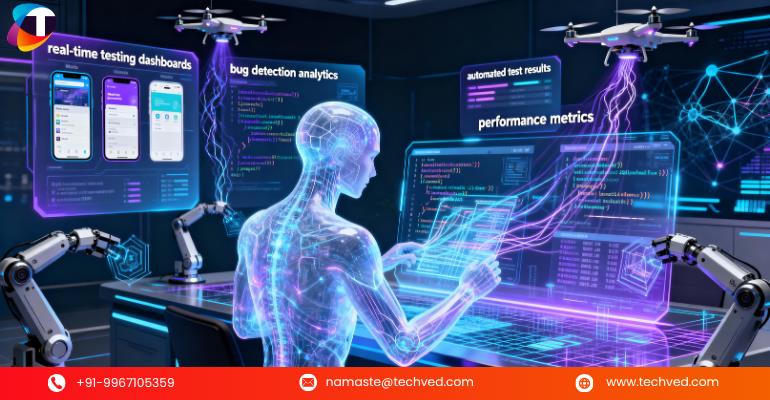
If you’ve ever spent long hours testing features, fixing bugs, and re-testing the same flows again and again, you’ll relate to one common frustration: testing takes time, and delays in testing often delay the entire release. Teams want to move fast, but manual testing slows everything down. Even with the best tools, there’s always a risk of missing something.
That’s where AI enters the picture.
AI is reshaping application testing by making it faster, smarter, and far more accurate. It can spot errors before they become problems, reduce repetitive work, and adapt to changes in your product. Whether you work with web application testing, mobile application testing, or desktop application testing, AI helps teams move from reactive testing to proactive decision-making.
Read on to know how AI is transforming testing, why it matters for modern digital teams, and what benefits organizations can expect, what are effective strategies for application testing in agile environments, and more.
Gain practical insights, a fresh perspective, and a clear understanding of how AI can enhance your quality assurance processes.
Why AI Matters in Application Testing Today
The digital landscape is expanding. More users. More platforms. More devices. And more pressure to deliver flawless experiences.
But traditional testing often falls short because:
- It takes too long to execute
- It depends heavily on manual effort
- It struggles to scale across multiple devices and platforms
- It cannot always predict unexpected user behavior
AI helps solve these limitations by learning from patterns, analyzing large volumes of data, and supporting teams with intelligent recommendations.
1. AI Helps Automate Complex Test Scenarios
One of the biggest challenges in application testing is handling complex user journeys. These journeys often involve several steps, variable inputs, and unpredictable behavior.
AI can:
- Generate test cases automatically
- Identify missing test scenarios
- Predict which features are most likely to break
- Recommend the areas to prioritize
For example, in web application testing, AI tools can simulate thousands of user interactions, detect UI inconsistencies, and flag abnormal behavior instantly. This helps teams catch issues early instead of waiting for bugs to appear in production.
2. Faster and Smarter Mobile Application Testing
Users expect mobile apps to be smooth, responsive, and error-free. But with so many devices and operating systems, testing becomes complex.
AI supports mobile application testing by:
- Automatically checking app behavior across device variations
- Analyzing performance in real time
- Predicting crashes or bottlenecks
- Identifying layout and responsiveness issues
Instead of manually verifying each device, AI does the heavy lifting and ensures better test coverage.
3. Improving Desktop Application Testing with Predictive Intelligence
While mobile and web apps get more attention, desktop software still plays a major role in many enterprises. AI helps improve desktop application testing by learning from previous defects and identifying potential problem areas before testers even get started.
Predictive intelligence allows:
- Early detection of recurring issues
- Identification of areas with high failure probability
- Automated scripts that adapt to UI changes
This makes desktop testing more efficient and reliable.
4. Smarter Application Performance Testing with AI
Performance issues can make users abandon an app instantly. Slow loading screens, freezing, and crashes are all red flags.
AI enhances application performance testing by:
- Studying traffic patterns
- Predicting how the app will behave under peak load
- Detecting early indicators of performance failure
- Suggesting optimization areas
Instead of waiting for performance issues to occur, AI application testing helps teams tackle them proactively.
5. Enhanced Accuracy with Data-Driven Testing Techniques
AI brings a major advantage to testing teams: it handles data better than humans. This is especially useful in applications of data flow testing, where the tester needs to understand how data moves through the application.
AI systems can:
- Track data movement across modules
- Identify interruptions, weak points, and data collisions
- Ensure every step of data processing is validated
This boosts accuracy and reduces risks that may affect user trust or system stability.
6. Smarter Web Application Testing Tools Powered by AI
Many teams rely on web application testing tools, but traditional tools often need manual updates whenever the UI changes.
AI-powered tools offer:
- Self-healing scripts (they fix themselves when UI elements change)
- Automated detection of broken links and components
- Real-time defect analysis
- Smart test suggestions based on previous patterns
This reduces maintenance work and keeps test automation stable even when the product goes through rapid changes.
7. Increased Test Coverage Without Increasing Effort
One of the biggest challenges that teams face is balancing speed with testing depth.
AI helps by:
- Generating more test cases in less time
- Running multiple test scenarios in parallel
- Covering edge cases that manual testers may overlook
- Ensuring no part of the app is left untested
This means better quality without putting extra load on your QA team.
8. AI Supports Continuous Testing for Modern DevOps Teams
Today, many companies release updates frequently. Weekly. Daily. Sometimes several times a day. AI makes continuous testing more practical by:
- Detecting code changes
- Running only the relevant tests
- Prioritizing test cases based on risk
- Generating instant reports
This keeps the release pipeline moving smoothly and reduces bottlenecks.
The Future of Application Testing with AI
AI is not replacing testers. It is empowering them.
It frees testers from repetitive tasks and gives them deeper insights. Testers get to focus on strategy, creativity, analysis, and user experience the things humans do best.
The future of application testing will be:
- Smarter
- Faster
- More reliable
- Insight-driven
Organizations that embrace AI in testing now will gain a strong competitive edge, deliver better user experiences, and reduce operational risks.
Conclusion
AI is transforming application testing across all platforms web application testing, mobile application testing, and desktop application testing. It supports everything from automated test creation to prediction-based defect detection, making the entire QA process more efficient, scalable, and future-ready.
With AI-powered techniques, teams can also improve application performance testing, strengthen applications of data flow testing, and get more value from their web application testing tools.
At TECHVED, we aim to redefine digital experiences that are less complex, as we believe our AI-backed services will continue to shape the future of quality assurance, helping businesses release stronger, more stable, and more user-friendly applications.
To know more about how we do it, get in touch!
FAQs
1. How is AI used in application testing?
AI automates test creation, predicts defects, analyzes user behavior patterns, and improves accuracy across different types of application testing, including web, mobile, and desktop.
2. How does AI support web application testing?
AI helps web application testing by analyzing UI changes, detecting issues in real time, and improving automation stability through self-healing capabilities.
3. Can AI be used for mobile application testing?
Yes. AI enhances mobile application testing by running tests across devices, predicting crashes, and ensuring consistent performance.
4. What is the role of AI in application performance testing?
AI improves application performance testing by predicting load issues, detecting bottlenecks, and offering optimization suggestions.
5. How does AI improve applications of data flow testing?
AI supports applications of data flow testing by tracking data movement across modules, identifying weak areas, and ensuring data integrity throughout the system.
Most Popular
Multilingual UX for Indic Scripts: Where Regional Language Products Quietly Break
Data-Driven Decision-Making: The Overlooked Foundation of Digital Transformation
Accessibility in the Age of AI: Designing Inclusive Intelligent Experiences

Inclusive Mobile Design: Building Accessible Apps for Global Users

Anticipatory UX: Designing User Experiences That Predict Intent

Safe Innovation: Implementing AI Chatbots with Strict Data Privacy Guardrails

DPDP 2025 Readiness: Building Credible Platforms for a Data-First World
Written By
Jay Anthony
Marketing Head
He led efforts to develop a fully integrated marketing communications plan and growing team. He is responsible for successful corporate re-brand and update of all branded assets.

Stay up-to-date with
all new market trends and
happenings
 #MultilingualUX #IndicScripts #RegionalLanguage #DesignSystems #DigitalAccessibility #TECHVED #TECHVEDConsulting
Multilingual UX for Indic Scripts: Where Regional Language Products Quietly Break
#DataDrivenDecisionMaking #DigitalTransformation #EnterpriseAnalytics #BusinessIntelligence #TECHVED #TECHVEDConsulting
Data-Driven Decision-Making: The Overlooked Foundation of Digital Transformation
#Accessibility #DigitalAccessibility #InclusiveDesign #CustomerExperience #DigitalTransformation #EnterpriseAI #TECHVED #TECHVEDConsulting #ExperienceEngineering
Accessibility in the Age of AI: Designing Inclusive Intelligent Experiences
From Ideation To Digital Transformation
We take care of all your needs


