

- Home
- Services
- TECHVED AI
- Case studies
- CLIENTS
- About Us
- More

Let's get started
We believe in advancing your business growth with innovative ideations and strategies
Get In Touch


 Back
BackMultilingual Chatbots for Global Expansion and Rural Market Inclusion
#AIChatbot #MultilingualAI #DigitalInclusion

Jay Anthony
30 March 2026 | 8 min read
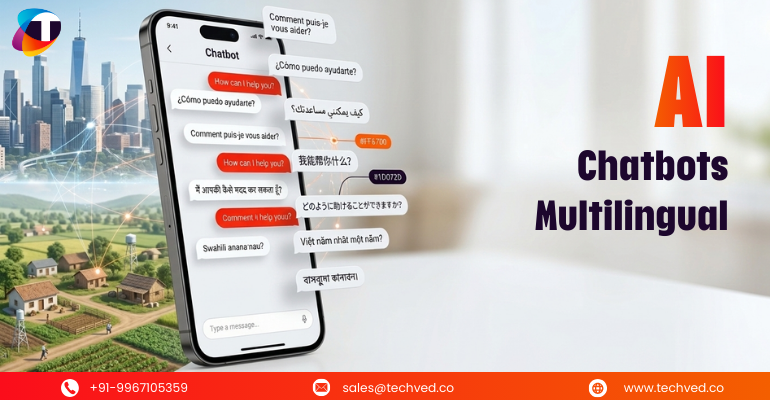
A farmer from rural Maharashtra, who speaks only in Marathi, logs in to an agricultural e-commerce platform seeking pest control advice. The platform has comprehensive information, detailed guides and helpful videos. But sadly, all in English. The farmer simply logs out feeling helpless.
This isn't unique to rural India. A Spanish-speaking customer in Texas, a Bengali speaker in London and a Tamil user in Singapore face identical barriers on digital platforms when AI chatbot interfaces only support major languages.
Language shouldn't determine who can access financial services, healthcare information or customer support. Yet millions remain excluded simply because digital interfaces don't speak their language.
Read on to understand how multilingual AI chatbot technology breaks these barriers, what chatbot customer experience looks like across languages and why serving diverse linguistic markets creates both social impact and business growth.
Why Multilingual Chatbots Matter
As businesses actively expand into diverse markets, varied set of users expect personalization and clarity suitable for them.
Multilingual AI chatbot services allow companies to communicate effectively without building separate platforms for each region. This improves reach, engagement and trust, across different user segments spanning different languages.
A capable chatbot development company ensures that language support feels natural and accurate rather than mechanical.
What Multilingual AI Chatbot Execution Requires
Language detection and switching- Users shouldn't search for language options. Smart AI chatbot development services detect preferred language from browser settings, location or initial input and switch seamlessly.
Culturally appropriate responses- Direct translation often fails. Some sentences translate literally but culturally inappropriate phrasing creates friction. Effective chatbot development company teams localize conversational patterns along with words.
Regional dialect support- The same language differs in different countries. Mexico’s Spanish is different from Spain’s Spanish. AI chatbot technology serving diverse markets needs dialect awareness beyond language codes.
Writing system and input method accommodation- Some languages use different orthographies. Arabic reads right-to-left. Indic languages use complex character combinations. Interface design must accommodate these differences.
Voice support for low-literacy users- Rural markets often have strong oral traditions but limited text literacy. Voice-enabled AI chatbot for technical support serves users who struggle with text-only interfaces.
Business Impact of Multilingual Chatbots
Market expansion without proportional cost.
AI chatbot development company solutions that support multiple languages serve new markets without hiring multilingual support teams for each language.
One chatbot scales across languages far more efficiently than human teams.
Customer satisfaction increases measurably.
Users prefer support in their native language. Chatbot customer experience satisfaction scores improve dramatically when language barriers disappear.
Conversion rates rise in underserved markets.
When rural or non-English users can actually understand product information and complete transactions, conversion improves. Language support directly impacts revenue.
Competitive differentiation in crowded markets.
Most competitors serve only major languages. Comprehensive multilingual support creates meaningful differentiation, particularly in AI chatbot services for B2B serving global supply chains.
Practical Applications Across Sectors
Multilingual AI chatbots are transforming multiple industries:
- Agriculture delivers personalized farming advice in local languages. Farmers access weather forecasts, market prices and pest management guidance through voice interfaces .
- Banking serves customers in their preferred languages. AI chatbots in banking handle transactions, answer queries and provide financial literacy support.
- Government services reach citizens at scale. AI voice outreach contacts millions across states with scheme information and service assistance .
- Global trade connects buyers and suppliers across language barriers. B2B platforms use AI chatbot automation in finance and compliance workflows
The Inclusive Design Principle
The best AI chatbot solutions share a common philosophy. They are built for inclusion from the ground up. They recognize that language is not a feature but a fundamental human right in the digital age.
This requires deep user research across linguistic and cultural contexts. It demands AI chatbot development services that prioritize accessibility alongside intelligence. It means testing with real users in real environments.
Final Thoughts
AI chatbot technology has matured to the point where language shouldn't limit who can access digital services.
Implementing multilingual practices is a proven strategy for serving underserved markets, supporting global operations and demonstrating genuine commitment to digital inclusion.
TECHVED delivers comprehensive AI chatbot development services with multilingual capabilities designed for both global enterprises and emerging market access. Our chatbot development company expertise spans language detection, cultural localization and low-resource language application.
Ready to break language barriers? Connect with TECHVED to explore multilingual AI chatbot services that expand market reach while advancing digital inclusion.
FAQs
What is an AI chatbot for multilingual markets?
AI chatbot for multilingual markets is an intelligent conversational interface that detects user language preferences and provides contextually appropriate responses in multiple languages with cultural localization.
Why do businesses need multilingual AI chatbots?
Multilingual AI chatbot technology expands addressable markets, improves customer satisfaction in diverse populations, enables global operations and creates competitive differentiation in underserved linguistic markets.
How do multilingual chatbots work?
Multilingual chatbots detect user language through browser settings or initial input, maintain conversation context across languages and generate culturally appropriate responses using language-specific training.
What challenges exist in multilingual chatbot development?
Challenges include training data scarcity for regional languages, maintaining brand consistency across translations, cultural appropriateness and testing with native speakers in each supported language.
How do multilingual AI chatbots serve rural markets?
AI chatbot services for rural markets support regional languages, accommodate voice input for low-literacy users, use culturally appropriate conversational patterns and provide information in locally relevant contexts.
Most Popular

Inclusive Mobile Design: Building Accessible Apps for Global Users

Anticipatory UX: Designing User Experiences That Predict Intent

Safe Innovation: Implementing AI Chatbots with Strict Data Privacy Guardrails

DPDP 2025 Readiness: Building Credible Platforms for a Data-First World

The Trust Economy: Viewing Cybersecurity as a Growth Strategy

Beyond Translation: Using BHAASHA to Build Cultural Trust
Hyper-Localization: Speaking the Customer Language for Global Growth
Written By
Jay Anthony
Marketing Head
He led efforts to develop a fully integrated marketing communications plan and growing team. He is responsible for successful corporate re-brand and update of all branded assets.

Stay up-to-date with
all new market trends and
happenings
 #InclusiveMobileDesign #MobileAccessibility #DigitalAccessibility
Inclusive Mobile Design: Building Accessible Apps for Global Users
#AnticipatoryUX #PredictiveUX #AIinUXDesign
Anticipatory UX: Designing User Experiences That Predict Intent
#AIChatbotSecurity #PrivacyFirst #ResponsibleAI
Safe Innovation: Implementing AI Chatbots with Strict Data Privacy Guardrails
From Ideation To Digital Transformation
We take care of all your needs


