

- Home
- Services
- AI Translation
- TECHVED AI
- Case studies
- CLIENTS
- More

Let's get started
We believe in advancing your business growth with innovative ideations and strategies
Get In Touch


 Back
BackAR/VR in Enterprises: Real Use Cases That Are Driving Business ROI
#ARVRMR #EnterpriseAR #ImmersiveTech

Jay Anthony
3 April 2026 | 8 min read
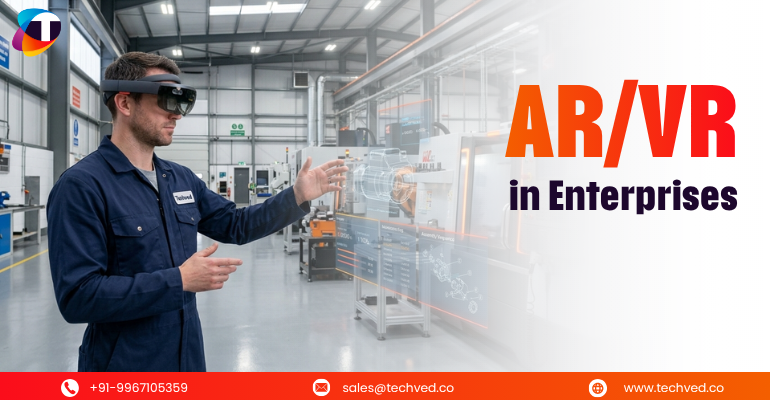
Remember the first time you tried on a VR headset or saw an augmented reality filter transform your face? What once felt like science fiction is now a powerful engine for enterprise growth.
In 2026, AR VR MR technologies are no longer just novelties. They are strategic investments delivering tangible returns across diverse industries. Businesses are leveraging these AR VR business applications to solve complex problems, enhance training and revolutionize customer experiences.
AR VR enterprise use cases have evolved from experimental pilots to proven applications delivering clear immersive technology ROI.
Understanding AR vs VR vs MR for Enterprise
To harness the power of immersive tech it is crucial to differentiate between its core forms:
Augmented Reality (AR): Overlays digital information onto the real world, often via smartphones or smart glasses. Think of maintenance technicians using AR to see repair instructions superimposed on machinery.
Virtual Reality (VR): Creates a fully simulated environment transporting users to a digital world via headsets. Ideal for immersive training simulations or virtual product design reviews.
Mixed Reality (MR): Blends AR and VR, allowing digital objects to interact with the physical world in real time. This enables collaborative design sessions where virtual models can be manipulated within a physical workspace.
Driving Business Value: Key AR VR Enterprise Use Cases
Enterprises are deploying AR VR solutions to achieve significant operational efficiencies and competitive advantages. Here are some prominent AR VR enterprise use cases
Manufacturing and Design: Engineers use digital twin technology to create virtual replicas of physical assets allowing for predictive maintenance, remote monitoring and collaborative design iterations. This reduces downtime and accelerates product development cycles.
Healthcare: Surgeons practice complex procedures in VR environments, minimizing risks and improving outcomes. AR assists nurses with patient care, providing real-time data overlays during rounds.
Retail and E-commerce: Customers use AR apps to virtually try on clothes or place furniture in their homes, boosting confidence in purchases and reducing returns. Virtual showrooms offer immersive product exploration.
Training and Development: High-risk industries like aviation and energy utilize VR for realistic training simulations. This provides hands-on experience without the dangers or costs of real world scenarios. An effective augmented reality strategy here ensures scalable and engaging learning.
Banking and Finance: While less visible, AR VR in banking is emerging for secure virtual meetings, advanced data visualization for analysts and even immersive client onboarding experiences. These AR VR development services are tailored to meet stringent security and compliance needs.
Measuring Immersive Technology ROI
Successful AR VR MR deployments track specific metrics.
By leveraging these technologies, organizations see significant quantifiable returns, starting with a 30-50% reduction in training time and a 20-40% improvement in error rates. Businesses also benefit from substantial travel cost savings through virtual collaboration and a faster time-to-competency for new hires.
Furthermore, virtual testing lowers physical prototyping expenses, while AR-assisted maintenance effectively decreases equipment downtime. Finally, these tools drive better bottom-line results by improving customer conversion rates and noticeably reducing product returns.
Enterprises achieving strong immersive technology ROI define success metrics before deployment and track them rigorously throughout implementation.
Building Effective Augmented Reality Strategy
Delivering immersive technology ROI requires strategic deployment. A sound augmented reality strategy includes:
- Start with clear business problems not technology competition
- Pilot with measurable KPIs like time saved or error reduction
- Scale based on proven results not speculative benefits
- Integrate with existing systems for seamless workflows
- Measure continuously to refine and optimize
Maximizing Immersive Technology ROI
The return on investment from AR VR MR is realized through reduced operational costs, improved safety, enhanced training effectiveness and increased customer engagement. Companies that partner with experienced providers like TECHVED can develop a robust augmented reality strategy and implement custom AR VR solutions that align with specific business objectives, ensuring measurable success.
Partner with TECHVED for Enterprise Immersion
At TECHVED, we deliver AR VR development services focused on business outcomes. Our AR VR solutions start with use case validation and end with measurable ROI. We help enterprises confidently move from pilot to scale.
We understand that immersive technology must earn its place. We design solutions that do exactly that.
Ready to capture AR VR MR ROI for your enterprise? Partner with TECHVED to navigate this immersive landscape and transform your business.
FAQs
What is the ROI of AR VR in enterprises? Enterprise AR VR investments typically achieve payback in 6 to 18 months through reduced travel, faster training, fewer errors and lower downtime. Proven AR VR enterprise use cases deliver 30 to 70 percent efficiency gains .
What is a digital twin? A digital twin is a virtual replica of physical assets or systems, enabling simulation, predictive maintenance and performance optimization without touching real equipment .
How does AR VR help in banking? AR VR in banking enables immersive client presentations, virtual trading floors and complex data visualization. These applications improve decision-making and client engagement .
Which industries benefit most from immersive technology? Manufacturing, energy, healthcare, retail and financial services lead in AR VR business applications. Any industry with complex training, remote operations or design collaboration can benefit.
How do I start with enterprise AR VR? Start with a focused pilot addressing a specific business problem. Define clear KPIs. Partner with experienced AR VR development services providers like TECHVED to ensure measurable outcomes.
Most Popular
Multilingual UX for Indic Scripts: Where Regional Language Products Quietly Break

Data-Driven Decision-Making: The Overlooked Foundation of Digital Transformation
Accessibility in the Age of AI: Designing Inclusive Intelligent Experiences
Inclusive Mobile Design: Building Accessible Apps for Global Users
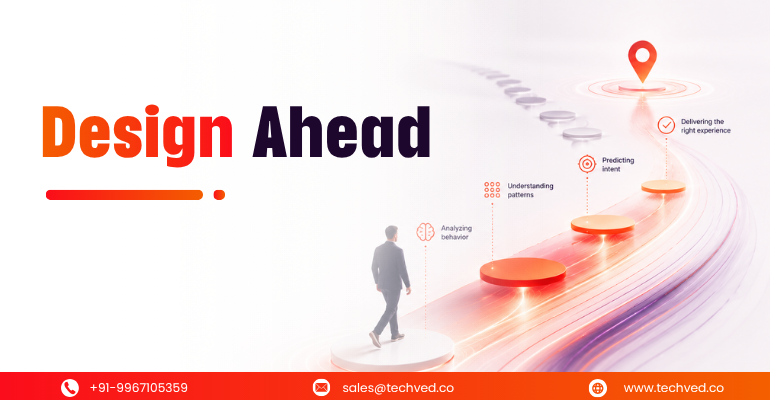
Anticipatory UX: Designing User Experiences That Predict Intent
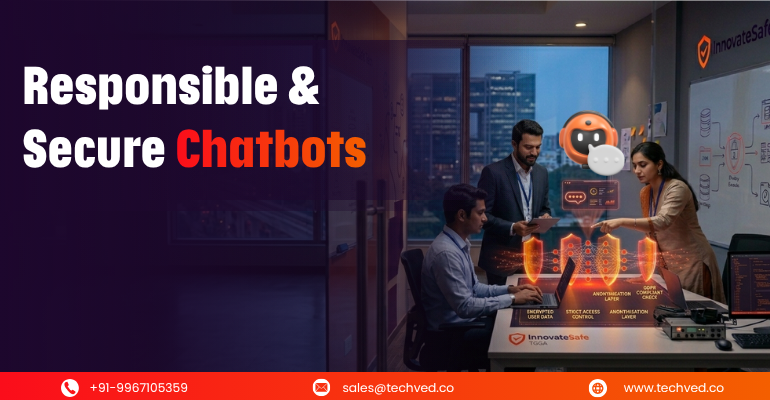
Safe Innovation: Implementing AI Chatbots with Strict Data Privacy Guardrails

DPDP 2025 Readiness: Building Credible Platforms for a Data-First World
Written By
Jay Anthony
Marketing Head
He led efforts to develop a fully integrated marketing communications plan and growing team. He is responsible for successful corporate re-brand and update of all branded assets.

Stay up-to-date with
all new market trends and
happenings
 #MultilingualUX #IndicScripts #RegionalLanguage #DesignSystems #DigitalAccessibility #TECHVED #TECHVEDConsulting
Multilingual UX for Indic Scripts: Where Regional Language Products Quietly Break
#DataDrivenDecisionMaking #DigitalTransformation #EnterpriseAnalytics #BusinessIntelligence #TECHVED #TECHVEDConsulting
Data-Driven Decision-Making: The Overlooked Foundation of Digital Transformation
#Accessibility #DigitalAccessibility #InclusiveDesign #CustomerExperience #DigitalTransformation #EnterpriseAI #TECHVED #TECHVEDConsulting #ExperienceEngineering
Accessibility in the Age of AI: Designing Inclusive Intelligent Experiences
From Ideation To Digital Transformation
We take care of all your needs


