

- Home
- Services
- Automated Translation
- TECHVED AI
- Case studies
- CLIENTS
- More

Let's get started
We believe in advancing your business growth with innovative ideations and strategies
Get In Touch


 Back
BackAI in User Research and Usability Testing
#UserResearch #UsabilityTesting

Jay Anthony
23 February 2023 | 8 min read
AI In User Research & Usability Testing
In recent years, the field of user research and usability testing has seen a significant transformation with the advent of Artificial Intelligence (AI) and its various applications. With the increasing advancements in AI technology, the impact it has on various industries has been profound. AI has the potential to bring about a revolution in user research, making it more efficient and effective.
In this blog, we will be exploring the ways AI has been incorporated in user research and usability testing, its benefits and limitations, and what the future of AI in user research might look like. We will also look at the ethical considerations and security implications of using AI in user research and the best AI tools available in the market today.
User research is a critical aspect of designing a product that meets the needs and expectations of the end-users. The process involves gathering data and insights about users' needs, behaviors, and preferences to design better products. Usability testing, on the other hand, involves evaluating a product's ease of use and the level of user satisfaction.
AI has been introduced in user research and usability testing to automate certain tasks, provide real-time feedback, and provide insights that were previously impossible to obtain through manual methods. With AI, user research can be conducted on a large scale and with greater accuracy.
However, AI should be used in conjunction with human researchers and the ethical and security implications of using AI must be considered. The limitations and ethical implications of AI must be understood and considered when using AI in user research.
New AI Interfaces
One of the most significant impacts of AI in user research has been the introduction of new AI interfaces. AI-powered virtual assistants and chatbots have become popular in recent years, and they have opened up new possibilities for user research and usability testing. AI-powered interfaces can provide real-time feedback and insights, and they can be used to conduct virtual user testing and provide real-time feedback.
Ways to Incorporate AI with User Research
There are several ways in which AI can be incorporated with user research to improve its accuracy and efficiency. Some of the ways are:
Evaluation of AI Logic
AI algorithms are designed to provide insights based on the data they are trained on. However, the accuracy of these algorithms is subject to the quality of the data they are trained on. AI algorithms can be evaluated to determine their accuracy and the quality of insights they provide.
Reporting on Findings
AI can be used to automate the reporting process in user research analysis, making it faster and more accurate. AI algorithms can be used to analyze data and provide insights, which can be used to generate reports.
Can Early-Stage Research Be Done
Early-stage research involves gathering data and insights about users' needs and behaviors to design better products. AI can be used to automate certain aspects of early-stage research, making the process faster and more efficient.
Does Context Matter
Context matters in user research and usability testing as it can impact the insights that are obtained. AI algorithms must be trained on data that is representative of the context in which the product will be used.
Accessibility Matters Too
Accessibility is a critical aspect of user research and usability testing, and AI must be designed to accommodate users with disabilities. AI algorithms must be tested to ensure they are accessible to users with disabilities, and any issues must be addressed before they are deployed in the real-world.
User Research Meets Security Testing
User research and usability testing must also consider the security implications of using AI. AI algorithms must be tested for vulnerabilities and potential security breaches to ensure that they are secure and reliable.
What are the Limitations of AI with User Research?
AI has several limitations when it comes to user research and usability testing. Some of the limitations include:
1. AI algorithms are dependent on the quality of data they are trained on, and if the data is biased, the insights generated by AI algorithms can also be biased.
2. AI algorithms are not able to account for cultural and societal differences, and therefore, the insights generated by AI algorithms may not be accurate in certain contexts.
3. AI algorithms may not be able to provide the same level of empathy and understanding as a human researcher, and therefore, certain insights may be missed.
Is AI The Future of User Research?
While AI has several limitations, it has the potential to revolutionize the field of user research and usability testing. AI can automate certain tasks, provide real-time feedback, and provide insights that were previously impossible to obtain through manual methods.
However, AI must be used in conjunction with human researchers to provide the best results. AI algorithms can be used to generate insights, but human researchers must interpret the results and determine the best course of action.
Conclusion
In conclusion, AI has the potential to bring significant advancements in the field of user research and usability testing. AI algorithms can automate certain tasks, provide real-time feedback, and generate insights that were previously impossible to obtain through manual methods. However, it's crucial to understand that AI should be used in conjunction with human researchers to provide the best results. Human researchers must validate and interpret the findings generated by AI algorithms to ensure accuracy and unbiased insights.
Moreover, the ethical and security implications of using AI in conducting user research must be taken into consideration. AI algorithms collect and store vast amounts of personal data, making privacy a concern. Additionally, AI algorithms are vulnerable to hacking and cyberattacks, making security a concern. Bias is also a concern as AI algorithms are dependent on the quality of data they are trained on, and if the data is biased, the insights generated by AI algorithms can also be biased.
AI has the potential to revolutionize the field of user research and usability testing, but it must be used with caution and in conjunction with human researchers. The limitations and ethical implications of AI must be understood and considered when using AI in user research.
FAQS
Can AI be trusted to provide accurate and unbiased insights in user research?
AI algorithms can provide accurate insights, but the accuracy of the insights depends on the quality of the data they are trained on. If the data is biased, the insights generated by AI algorithms can also be biased. To ensure accurate and unbiased insights, human researchers must interpret the results and validate the findings in any ux research services.
What are the ethical considerations for using AI in user research?
There are several ethical considerations for using AI in user research, including privacy, security, and bias. Privacy is a concern because AI algorithms collect and store vast amounts of personal data. Security is a concern because AI algorithms are vulnerable to hacking and cyberattacks. Bias is a concern because AI algorithms are dependent on the quality of data they are trained on and if the data is biased, the insights generated by AI algorithms can also be biased.
What are the best AI tools for user research and why?
The best AI tools for user research depend on the specific needs and goals of the research project. Some popular AI tools for user research include Qualtrics, Mixpanel, and UserTesting. These tools are popular because they are user-friendly, provide real-time feedback, and provide insights that were previously impossible to obtain through manual methods.
How can AI be used to automate user research processes?
AI can be used in conducting user research processes by automating certain tasks, such as data collection and analysis. AI algorithms can be used to analyze large amounts of data in real-time and provide insights that were previously impossible to obtain through manual methods. This allows human researchers to focus on more complex tasks, such as interpreting the results and determining the best course of action.
Can AI be used to conduct virtual user testing and provide real-time feedback?
Yes, AI can be used to conduct virtual user testing and provide real-time feedback. AI algorithms can be used to analyze user interactions in real-time and provide feedback on user experience, design, and functionality. This allows designers and developers to make rapid improvements to the user experience based on real-time feedback.
Most Popular

Data-Driven Decision-Making: The Overlooked Foundation of Digital Transformation
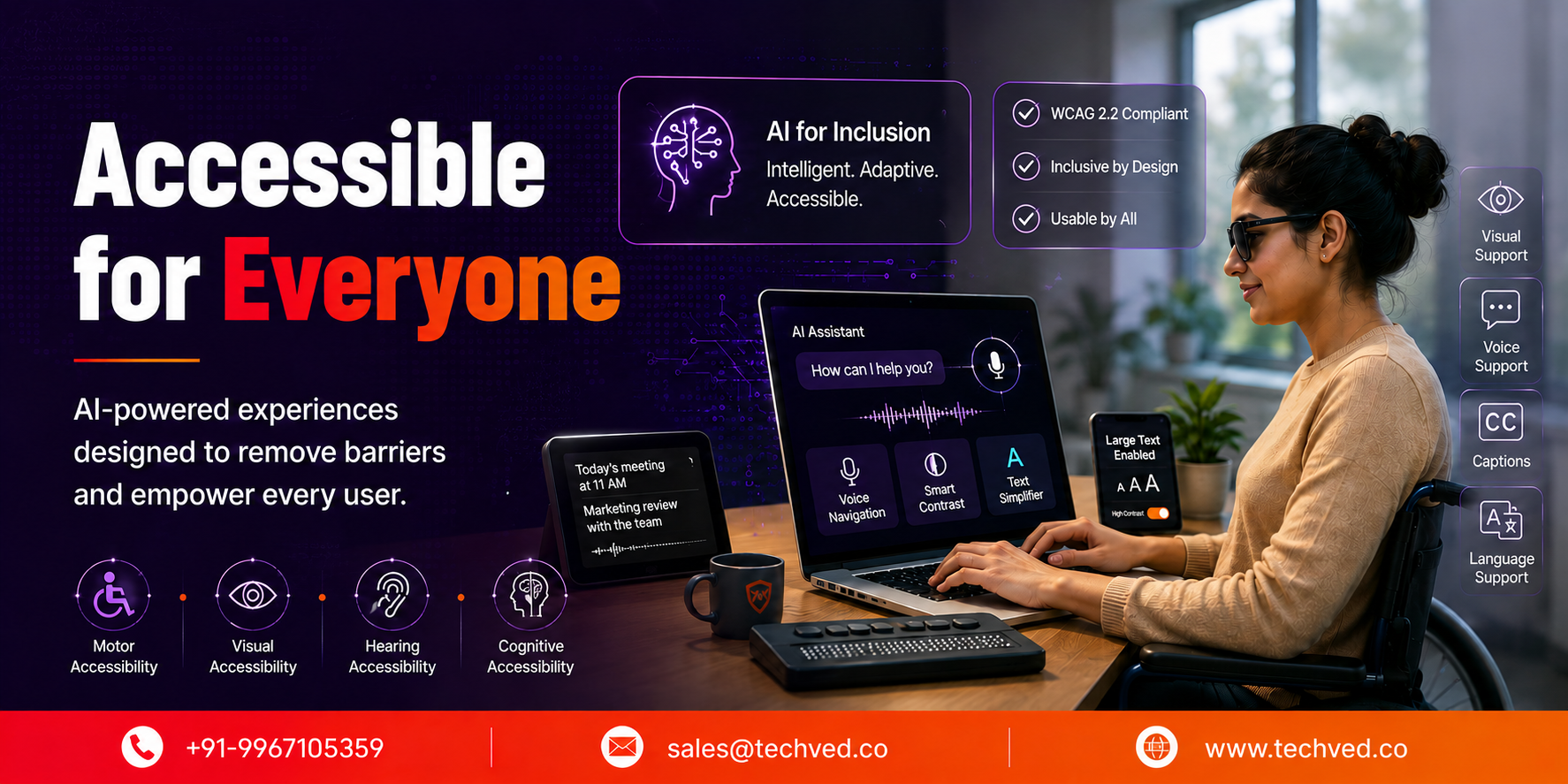
Accessibility in the Age of AI: Designing Inclusive Intelligent Experiences

Inclusive Mobile Design: Building Accessible Apps for Global Users

Anticipatory UX: Designing User Experiences That Predict Intent

Safe Innovation: Implementing AI Chatbots with Strict Data Privacy Guardrails

DPDP 2025 Readiness: Building Credible Platforms for a Data-First World

The Trust Economy: Viewing Cybersecurity as a Growth Strategy
Written By
Jay Anthony
Marketing Head
He led efforts to develop a fully integrated marketing communications plan and growing team. He is responsible for successful corporate re-brand and update of all branded assets.

Stay up-to-date with
all new market trends and
happenings
 #DataDrivenDecisionMaking #DigitalTransformation #EnterpriseAnalytics #BusinessIntelligence #TECHVED #TECHVEDConsulting
Data-Driven Decision-Making: The Overlooked Foundation of Digital Transformation
#Accessibility #DigitalAccessibility #InclusiveDesign #CustomerExperience #DigitalTransformation #EnterpriseAI #TECHVED #TECHVEDConsulting #ExperienceEngineering
Accessibility in the Age of AI: Designing Inclusive Intelligent Experiences
#InclusiveMobileDesign #MobileAccessibility #DigitalAccessibility
Inclusive Mobile Design: Building Accessible Apps for Global Users
From Ideation To Digital Transformation
We take care of all your needs


