

- Home
- Services
- Automated Translation
- TECHVED AI
- Case studies
- CLIENTS
- More

Let's get started
We believe in advancing your business growth with innovative ideations and strategies
Get In Touch


 Back
BackTouching the Next Billion: Designing for Permanent and Situational Disability
#InclusiveInnovation #AccessibilityFirst #UniversalDesign

Jay Anthony
9 June 2026 | 8 min read
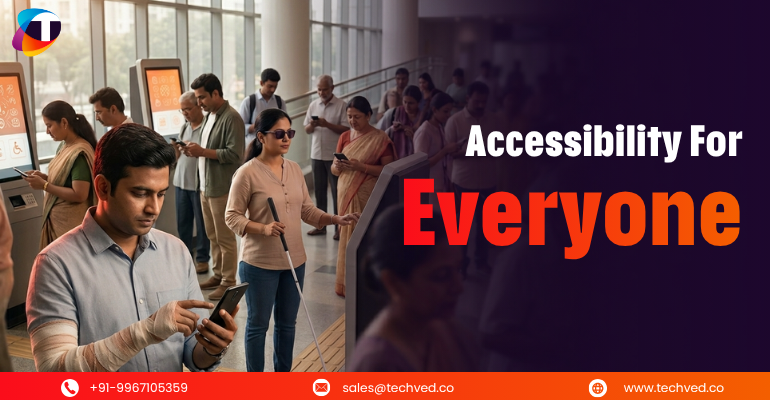
You are holding your newborn with one arm while trying to reschedule a doctor's appointment with the other. The app demands two-handed precision. Your free hand struggles with small buttons and precise swipes. This is a situational disability. It is temporary but just as real as a permanent one. Now imagine someone with permanent motor impairment facing that interface every single day.
Inclusive innovation recognizes that disability is not a fixed category. It affects all of us at different times. Designing for permanent and situational disabilities opens digital products to the next billion users. When we remove barriers for some, we improve experience for all.
The Scale of Disability Design Opportunity
Disability isn't rare. It's universal.
1.3 billion people live with permanent disabilities: visual impairments, hearing loss, motor challenges, cognitive differences and combinations thereof.
Billions more experience situational disability: new parents can't use both hands, people in bright sunlight can't see screens, travelers on trains can't hear audio clearly, people with broken arms can't type.
When you design for digital accessibility for permanent disabilities, you create better experiences for everyone experiencing situational challenges.
Captions help deaf users and people in noisy environments. Voice interfaces assist people with motor impairments and those carrying groceries. High contrast modes work for people with vision loss and anyone in bright sunlight.
Inclusive product design isn't serving minorities. It's serving human reality in all its diversity.
The Next Billion Opportunity
Over 1.3 billion people worldwide live with significant disabilities. Their spending power exceeds $13 trillion annually. Yet 96 percent of the world's top million websites fail accessibility standards. This is not a niche market. It is the largest underserved audience in digital history.
Digital accessibility for permanent disabilities expands reach. Situational disability UX design improves experience for everyone. The same voice command that helps a blind user also helps a driver with hands on the wheel.
Key Principles of Inclusive Product Design
Inclusive product design principles guide this approach:
- Equitable use- The design is useful and marketable to people with diverse abilities
- Flexibility in use- The design accommodates a wide range of individual preferences and abilities
- Simple and intuitive- Use of the design is easy to understand regardless of user experience or language skills
- Perceptible information- The design communicates necessary information effectively regardless of ambient conditions or user's sensory abilities
- Tolerance for error- The design minimizes hazards and adverse consequences of accidental actions
- Low physical effort- The design can be used efficiently and comfortably with minimal fatigue
- Size and space for approach- Appropriate size and space is provided for regardless of user's body size posture or mobility
Voice-First Design as an Accessibility Superpower
Voice-first design for accessibility transforms digital interaction. For users with limited mobility or vision, voice becomes the primary input method. For users in situational contexts (driving, cooking, hands full), voice is a lifeline.
Voice interfaces must handle:
- Varied speech patterns and accents
- Background noise and low volume
- Command ambiguity and clarification
- Private spaces where speaking is inappropriate (offering text alternatives)
Situational Disability UX Design in Action
Situational disability UX design solves everyday problems:
- A parent holding groceries cannot type. Voice search saves them.
- A user in bright sunlight cannot read low-contrast text. High contrast mode saves them.
- A user with a broken arm cannot pinch-to-zoom. One-tap zoom saves them.
- A user in a loud café cannot hear audio cues. Visual notifications save them.
These solutions originated from disability-first design thinking. They now benefit everyone.
Accessibility as Competitive Advantage
Accessibility as competitive advantage operates on multiple levels:
Market reach expands immediately- Every accessibility improvement serves previously excluded populations.
User satisfaction improves across populations- Voice interface isn't just for accessibility. It's preferred by many users regardless of ability.
Legal risk decreases- Accessibility litigation increases annually. Proactive design prevents expensive remediation.
Brand reputation strengthens- Companies known for inclusive design attract customers valuing social responsibility.
Innovation accelerates- Designing for extreme use cases often yields innovations serving mainstream users.
Practical Steps for Inclusive Innovation
Start with disability-first design thinking:
- Audit your product with automated tools and real users with disabilities
- Train your team on inclusive design principles and assistive technologies
- Build with semantic HTML and proper ARIA labels from day one
- Test with screen readers (NVDA, JAWS, VoiceOver) weekly
- Include accessibility in design sprints not as an afterthought
Final Thoughts
Inclusive innovation isn't about helping minorities. It's about designing for human reality in all its diversity.
The next billion users accessing digital products deserve experiences designed for their needs, not accessibility patched onto incompatible systems.
TECHVED delivers universal design for digital platforms combining accessibility expertise with product thinking. Our inclusive product design approach expands markets while improving experiences for everyone.
Ready to design for human diversity? Connect with TECHVED to explore disability-first design thinking reaching the next billion.
FAQs
What is inclusive innovation? Inclusive innovation is the practice of designing products and services that work for people of all abilities and circumstances. It includes digital accessibility for permanent disabilities and situational disability UX design.
How does situational disability differ from permanent disability? A permanent disability is long-term (vision loss, paralysis). A situational disability is temporary (broken arm, noisy environment, holding a baby). Inclusive product design principles address both.
What is disability-first design thinking? Disability-first design thinking starts with the most challenging use cases (users with significant disabilities) then expands to everyone. Solutions that work for extreme limitations work better for all.
How does voice-first design improve accessibility? Voice-first design for accessibility enables hands-free eyes-free interaction. It serves users with motor or vision limitations while benefiting drivers, parents and multitaskers.
Why choose TECHVED for inclusive design? TECHVED delivers universal design for digital platforms grounded in disability-first design thinking. We help you turn accessibility as competitive advantage into measurable growth.
Most Popular

Data-Driven Decision-Making: The Overlooked Foundation of Digital Transformation
Accessibility in the Age of AI: Designing Inclusive Intelligent Experiences
Inclusive Mobile Design: Building Accessible Apps for Global Users
Anticipatory UX: Designing User Experiences That Predict Intent

Safe Innovation: Implementing AI Chatbots with Strict Data Privacy Guardrails

DPDP 2025 Readiness: Building Credible Platforms for a Data-First World

The Trust Economy: Viewing Cybersecurity as a Growth Strategy
Written By
Jay Anthony
Marketing Head
He led efforts to develop a fully integrated marketing communications plan and growing team. He is responsible for successful corporate re-brand and update of all branded assets.

Stay up-to-date with
all new market trends and
happenings
 #DataDrivenDecisionMaking #DigitalTransformation #EnterpriseAnalytics #BusinessIntelligence #TECHVED #TECHVEDConsulting
Data-Driven Decision-Making: The Overlooked Foundation of Digital Transformation
#Accessibility #DigitalAccessibility #InclusiveDesign #CustomerExperience #DigitalTransformation #EnterpriseAI #TECHVED #TECHVEDConsulting #ExperienceEngineering
Accessibility in the Age of AI: Designing Inclusive Intelligent Experiences
#InclusiveMobileDesign #MobileAccessibility #DigitalAccessibility
Inclusive Mobile Design: Building Accessible Apps for Global Users
From Ideation To Digital Transformation
We take care of all your needs


